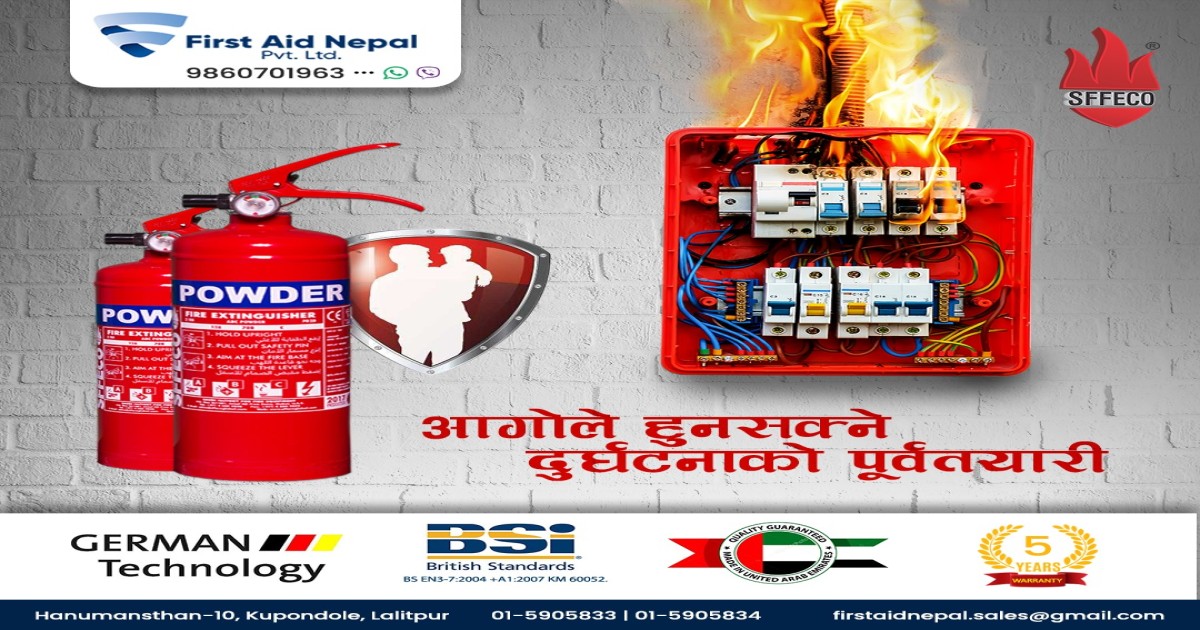
All about Fire Extinguishers in Nepal
May 27th 2026


A fire hose is an important part of a building’s fire protection system. The Fire Hose helps bring water to the fire and provides a means to extinguish the fire before it gets out of hand for people or firefighters. But not all fire hoses are created equal. There are different designs and uses of fire hose reels, RRL hose pipes, suction hose and canvas delivery hose. It is important to select the type since it needs to match the water pressure, fire protection system and location where it will be used. One hose may be appropriate for one use but inappropriate for another.
In Nepal, fire hoses are used in homes, apartments, offices, hotels, hospitals, factories, warehouses, and other commercial buildings. The type of hose required may be dependent on the size of the building, hydrant system, water supply, pump output and firefighting needs. Recognizing these differences can enable building owners and facility managers to select appropriate equipment rather than choosing equipment just for its appearance or cost. The right fire hose in Nepal for firefighting should be strong, compatible with the system, and easily accessible and safe to use.

Most buildings in Nepal are equipped with fire hoses as a part of fire safety system. Only having fire hoses is not enough for the building to have a good fire protection system. There are many types of fire hoses designed for different uses, and therefore using the incorrect one may influence the efficiency of the fire protection system in case of fire outbreak. The most widespread mistake that people make when choosing the hose is basing the choice on its visual appearance, size, or cost.
Another common problem is confusing a fire hose reel in Nepal with a delivery hose. The hose reel is typically used to respond to a fire in the first minutes, and the delivery hose is tied to the hydrant system for the fire response. There is also some confusion over the distinction between RRL hose pipes, suction hoses and canvas delivery hoses among building owners. The purpose of the fire hose determines which type should be selected, and it is crucial to select the right type based on the building’s fire protection system. When buying the hose, you must needs to consider a number of things; such as size, length, pressure, fittings, construction, and use.

Choosing the right fire hose is important for the proper working of a fire protection system. There are various hoses, depending on varying water pressure, connections, and firefighting conditions. When using the wrong type of hose, it might affect the efficiency of the process. The right selection helps enhance safety during an emergency as well.
Each fire hose is designed to handle a certain level of water pressure. A lower pressure rating hose may not work with a high pressure hydrant system. The test pressure and the working pressure should be checked to ensure that the hose will withstand the flow of water from the pump.
The hose should be long enough to cover the area which requires protection. A hose that is too short may not provide enough coverage during a fire. The length of hose required, however, should relate to the building's layout, as an unnecessarily long hose can be difficult to carry, store and use.
Fire hoses must be of a suitable type and fitted with the proper coupling for connection with hydrant valves, nozzles, pumps or other equipment. The wrong coupling may lead to leakage or make it impossible to connect the hose in an emergency. The connection must always be compatible with the installed fire protection systems.
Different materials and layers are used in the construction of fire hoses for specific uses. Some are studied to provide high-pressure water delivery and others are built to provide suction or to provide water fast in the first response. Hose with good construction will resist high pressure, frequent handling, and storage conditions.
The fire hose must always be chosen for the location and application of use. A fire hose reel in Nepal can be adapted to provide fast initial response, and an RRL delivery hose is typically coupled to a hydrant system. The suction hoses in fire pump systems are for other purposes.

RRL delivery hose pipes are an integral component of numerous fire hydrants systems. They are designed to carry pressurized water from the hydrant valve to the area where firefighting is required. They are well-constructed and can be used in emergencies to carry water as it is under pressure. The diameter, pressure, and hose mounted on the building's hydrants should correspond to the appropriate RRL hose.
RRL is a term that refers to Rubber Reinforced Lined hose. Power delivery hose with high strength and commonly used in fire hydrant system to send water from hydrant valve to fire. It can be used to carry pressurized water and typically is connected to a branch pipe and/or nozzle. RRL hose pipes are well established for use where there is a need for a good water delivery system.
Depending on the manufacturer and application, the specifications of an RRL hose pipe can differ. Typical requirements are hose diameter, length, working pressure, test pressure, hose lining material, reinforcement and coupling type. An appropriate hose must be capable of withstanding the pressure of the building's hydrant system, as well as possessing appropriate connections.
RRL delivery hoses are mainly used with fire hydrant systems in buildings and industrial facilities. They can be used in apartments, hotels, hospitals, offices, factories, warehouses, shopping complexes, schools and other commercial buildings. It may be used when a hose must be attached to the hydrant and pressure water fed into a fire by a fire fighter or trained individual.
First Aid Nepal offers RRL hose pipe in Nepal and other fire safety and firefighting equipment. Also, the customer can view the specifications available and seek help in determining what type of hose may be used within their building. We can also give you information on fire hydrant equipment and other fire protection solutions to your questions answered by an experienced team.
A fire hose reel is intended to quickly respond to a fire occurring within a building. It offers a readily available water source and may be used to put out a small fire before it gets out of hand. A fixed reel is designed to store the hose in a neat and tidy position which allows rapid access, easy unwinding and use of the hose during an emergency situation.
The fire hose reel consists of a fire hose which is wound around an equipment referred to as a fire hose reel, water source attachment, and nozzle to control the flow of water from the hose. A fire hose reel is often wall-mounted or fixed into a specially made cabinet. Due to its simple construction, it allows the fire hose to be deployed quickly and directed towards the fire.
Specifications may differ from model to model and manufacturer to manufacturer. Factors of importance are the length, diameter, working pressure of the hose, the construction of the reel, the type of nozzle, and connection of the water. The chosen reel should fit the building's fire protection system and give adequate hosing length of the area to be covered.
Fire hoses are usually found in buildings such as, apartments, offices, hotels, hospitals, schools, shopping centers, warehouses, factories, and other types of buildings. They are usually found in hallways, stairways, exits, or any accessible location. The area of hose coverage for the protected space must be adequate and access to the area for the installation must be easy and fast.
First Aid Nepal has various fire hose reel in Nepal available with other firefighting and fire safety equipments. We can help customers understand the available options and select equipment according to their building requirements. Our team can offer fire solutions like fire safety AMC, fire safety design and consulting along with hydrant systems.
A suction hose has a different function from a regular delivery hose. It is primarily used to pump water from a tank, reservoir or other water supply to a fire pump. Its strong and rigid construction helps prevent the hose from collapsing when the pump creates suction. This makes it an important part of certain fire pump and firefighting setups.
A heavy duty hose used to transport water under suction is a suction hose. It is linked between the water source and the incoming of a fire pump. A suction hose is used to draw water into the pump and is not a delivery hose, as this brings water into the pump from the pressurized delivery hose.
Suction hoses are designed to withstand negative pressure and maintain their shape while water is being drawn into the pump. Specifications may be different depending on the application and pump system. There are factors to take into account, such as hose diameter, hose length, pressure rating, construction, hose flexibility, and the type of hose coupling.
It is common to use the suction hose in fire pump rooms, fire brigade operations and firefighting systems that have water from a tank, reservoir, pond or other natural source. These can be helpful when a pump must draw water from an external source, or when the pump is storing water. The hose and hook-up should be compatible with the pump and water supply system.
First Aid Nepal provides firefighting equipments and appropriate fire safety products to various building and industry needs. Our team is there to provide customers with details regarding appropriate fire hose solutions, including for pumps systems that need to be compatible to use a suction hose.
The canvas delivery hose is often used for the transport of pressurized water in fighting fires. It has been manufactured in such a way that it can be flexibly rolled up for ease of transport and storage. Being light in weight makes it convenient to carry to the place where the fire has occurred.
A canvas delivery hose is a flexible hose for moving water from a hydrant, pump or other water supply to the fire. It can be rolled up when not in use, making it easy to store and carry. Depending on the firefighting system and application, appropriate couplings and nozzles are installed.
Canvas delivery hoses come in various sizes and specs, based on their applications. The factors include hose diameter, hose length, working pressure, test pressure, hose material, reinforcement, and coupling type. The hose must be chosen based on the water pressure it will be connected to and the equipment it will be connected to.
Canvas delivery hoses are primarily employed for firefighting and fire brigade operations that require hoses to be carried, deployed and stored with ease. They can also be incorporated with appropriate hydrant systems and firefighting equipment. The size, length and pressure rating of the hose necessary for the use depends on the application and equipment.
Canvas delivery hoses may not always be available based on current stock and project requirements. For fire hose in Nepal, you may contact with First Aid Nepal to enquire about the available options and to find out which alternative can be suitable for your building or firefighting system. Our team can also provide information about other fire safety equipment and related services.

Each building requires different types of fire hoses based on their fire protection systems. Hoses are manufactured for different uses and a hose designed, for an apartment may not be appropriate for a fire pump room or factory. Factors such as water pressure, hose length, building layout, pump capacity, and connection type should be considered before making a purchase. A simple comparison of the main fire hose types and their typical application is provided in the table below.
| Fire Hose Type | What It Is | Main Use | Commonly Used In | Important Things to Check |
| Fire Hose Reel | A hose stored on a fixed reel with a nozzle and water connection | Quick first response to control a small fire | Apartments, offices, hotels, hospitals, schools, shopping centres, and other commercial buildings | Hose length, diameter, working pressure, nozzle, reel quality, and water connection |
| RRL Delivery Hose | A reinforced delivery hose designed to carry pressurized water | Main firefighting hose for hydrant systems | Factories, warehouses, hotels, hospitals, apartments, commercial buildings, and industrial facilities | Diameter, length, working pressure, test pressure, material, reinforcement, and coupling |
| Suction Hose | A strong hose designed to draw water into a fire pump | Transfers water from a tank, reservoir, or other source to the pump | Fire pump rooms, fire brigade operations, and systems using external water sources | Diameter, length, suction capability, construction, flexibility, and pump connection |
| Canvas Delivery Hose | A flexible and rollable hose for pressurized water delivery | Firefighting and fire brigade operations | Fire brigade use and suitable firefighting systems | Diameter, length, working pressure, material, reinforcement, and coupling |
| Fire Hydrant Hose | A delivery hose connected to a building's hydrant system | Directs pressurized water toward a fire | Large residential, commercial, industrial, and institutional buildings | Hydrant connection, pressure rating, hose length, nozzle, and system compatibility |
For a fire hose reel in Nepal, the main focus is quick access and ease of operation. For an RRL delivery hose, the focus is strong water delivery through the hydrant system. Suction hoses are selected according to the fire pump and water source, while canvas delivery hoses are generally used where flexible and portable firefighting equipment is required. Always check the complete fire protection system before selecting a hose rather than choosing one based only on price.
Looking for the right supplier of security systems in Nepal can make it easier to choose suitable products, and First Aid Nepal provides solutions based on your building’s specific requirements. First Aid Nepal has been providing fire safety products and services in Nepal for more than 16 years. Our team focuses on helping customers choose suitable equipment based on their building and fire protection requirements.
A reliable fire protection system depends on having the right equipment in the right place. The type of hose you choose can affect how quickly water reaches a fire and how easily the equipment can be handled during an emergency. Before installation, it is important to consider the building’s layout, areas that need protection, water supply, and how the firefighting equipment will be accessed. Regular inspection is also important to identify leaks, damaged couplings, worn-out sections, or other problems before the equipment is needed.
For building owners and facility managers, selecting suitable firefighting equipment is a practical step toward better fire preparedness. Professional advice can also be useful when replacing old hoses, setting up a new system, or checking whether existing equipment is suitable. A properly planned fire protection system can make emergency response more organized and effective. If you want to learn more about fire safety, equipment, and protection systems, please go through our other blogs too.
A fire hose reel is permanently mounted on a reel and is designed for quick first response. A fire hose pipe, such as an RRL delivery hose, is generally used with a fire hydrant system and provides a higher-volume water supply for firefighting. Both have different applications within a building's fire protection system.
RRL means Rubber Reinforced Lined hose. It is a reinforced delivery hose commonly used with fire hydrant systems. RRL hose pipes can be found in commercial buildings, factories, hotels, hospitals, warehouses, apartments, and other properties where a hydrant-based firefighting system is installed.
Common types include RRL delivery hoses, fire hose reels, suction hoses, and canvas delivery hoses. Each type has a different purpose. Delivery hoses carry pressurized water toward a fire, hose reels provide first response, suction hoses supply water to pumps, and canvas hoses are commonly used for firefighting applications.
The required length depends on the building's fire hydrant layout and system design. Fire hoses are available in different lengths, and the correct option should provide enough reach to cover the required area without creating unnecessary storage or handling problems. The building's fire safety design should determine the final hose length.
Fire hoses are available from fire safety equipment suppliers in Nepal. First Aid Nepal supplies fire hoses and other firefighting equipment and provides guidance based on the customer's requirements. Before purchasing, check the hose type, length, pressure rating, coupling, construction, and suitability for your fire protection system
May 27th 2026

July 24th 2026



Quick and delivery of innovative fire safety and electronic security solutions for better convenience and additional assurance

Professional setup and installation assistance by certified security experts to ensure complete safety.

Direct assistance from security experts ready to assist with product selection, installation, and queries.