All about Fire Extinguishers in Nepal
January 20th 2026

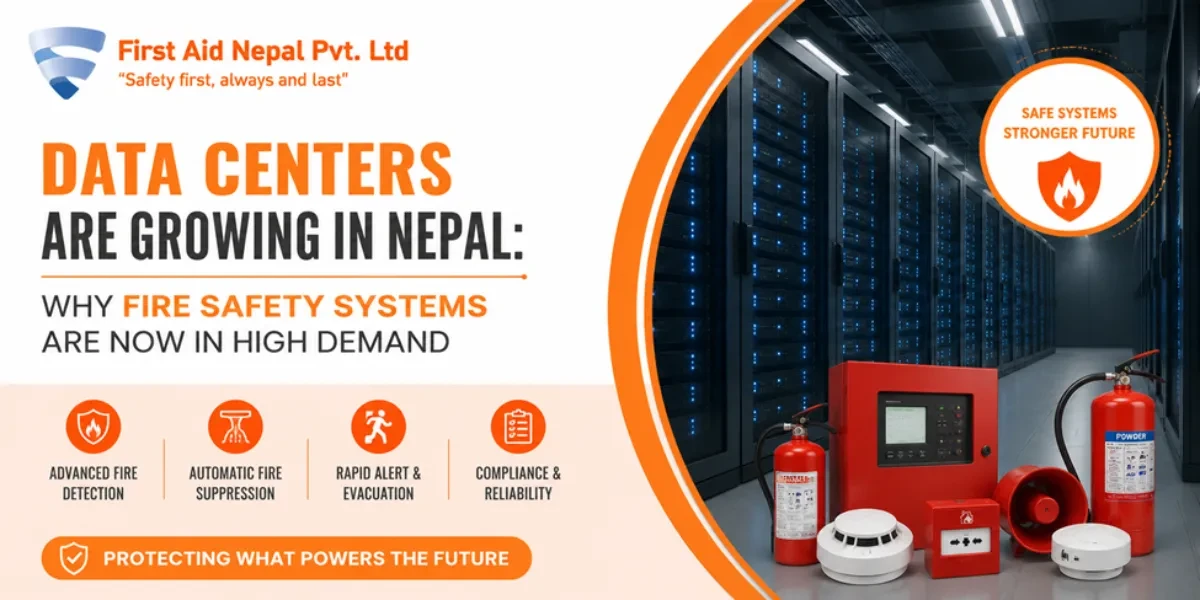
Nepal is rapidly evolving towards its digital transformation journey, and the requirement for secure/dependable data center infrastructures has rapidly grown. Numerous firms, ranging from banks and telecommunication operators to hospitals, financial technology organizations, and government entities, are making substantial investments in setting up their own data centers. These facilities are equipped with powerful electrical systems, battery backups powered by lithium-ion, dense racks of servers, cooling systems, and constant energy consumption. Even a small incident of fire can cause severe damage to equipment, data loss, downtime in operations, and financial implications. Fire safety systems are in high demand because of these factors.
This blog will provide you with information on fire safety for server rooms and data centres. This includes information about their development, the threat of fires in data centers, and the importance of data center fire protection systems. We should begin with all these considerations in mind
Over the last few years, digital services have grown quickly in Nepal. Digital systems such as online banking, ecommerce, digital wallets, and telemedicine are now a regular part of our lives. Businesses need reliable data centers to handle the increasing number of users who rely on digital platforms. They also require secure processing of information and uninterrupted operations.
Today, organizations manage huge amounts of sensitive data, such as customer records, financial transactions, and confidential business information, in addition to operational systems. There has been an increased demand for data storage solutions in Nepal. Companies have a preference for using data centers from the region since such centers provide better security, faster connectivity, compliance with laws, and protection from cyber or physical attacks.
There has been an increase in cloud computing services in Nepal. Firms have started to leverage cloud computing services for communication, application, storage, telecommuting, and administration purposes. There is an increase in cloud computing usage, which suggests that there should be more capacity at the data centers. This trend calls for investments in sophisticated and high-security server facilities in Nepal.
Transformation through digitization does not apply solely to the information technology field anymore. Different industries, such as the banking and healthcare sectors, hospitality, manufacturing, education, retail, and telecommunications industries, are making use of new digital technology to improve their services and processes. There is a requirement for data centers to facilitate business continuity and digital communications in Nepal.
These centers are located in sensitive areas, where even a minor fire can have a major impact on operations and finances. These facilities feature many electrical cables, power usage at all times, batteries, and other electrical devices that function all the time. There may arise the risk of fire in such institutions due to the electrical equipment they possess. It is highly important to recognize the threats involved with fire hazards. But the question now becomes - what are some of the risks posed by fire in the data center?

Nepal is experiencing major changes in its digital landscape. The need for data centres is growing as businesses, financial institutions, and telecom providers expand and develop, along with government agencies and technology companies. Large organizations are investing heavily in modern IT infrastructure in order to support online services and transactions. This increasing investment is changing Nepal's digital landscape, creating a greater demand for data centers that are safe, efficient, and can run continuously.
Lithium-ion batteries have been extensively employed in contemporary data centers as sources of backup power. While providing dependable backup and efficient energy storage, they can also cause fires when there is any damage, overheating, or improper maintenance. At times, lithium-ion battery systems may undergo thermal runaway that results in smoking and rapid spread of fire.
Electrical circuits are crucial in the functioning of data centers. They provide energy for the servers, cooling equipment, networking hardware, and storage hardware. The malfunctions of the electrical circuits, including short circuiting, overload, faulty connections, and changes in voltage, can result in sparking or overheating, which might ignite adjacent substances. Such buildings operate on a round-the-clock basis, and therefore any malfunction can lead to an emergency situation very quickly.
The heat produced by these IT devices is very significant whenever they are being used. If these cooling systems are ineffective or when there is restricted airflow, temperatures will rise very quickly. Prolonged overheating may cause damage to parts of the hardware and also pose a fire hazard. High-density server rack designs have to ensure proper temperature control in order to minimize fire hazards due to excessive heat.
The majority of data centers have large quantities of electrical and communications cables located beneath raised flooring and within server racks. Fires can result from several reasons, such as improper cable routing, worn or defective cable insulation, overcrowding of cables, and electrical wire damage. Fires in the area underneath the raised floor can be particularly hazardous because they may not be detected until they reach the server room itself.
The HVAC and cooling system of a data center plays a critical role in keeping temperatures safe. Failures in these systems may create more fire hazards. Temperatures can be increased by overheated motors or electrical problems, as well as blocked ventilation and cooling system failures. This will place additional stress on sensitive equipment. Inefficient cooling may indirectly cause server overheating or fire incidents.

Fire safety mechanisms are crucial in the protection of the IT infrastructure, which is costly to acquire and maintain. They will detect a fire outbreak and manage to put it out while at an early stage, hence avoiding any potential damage by smoke, flame, or excessive heat, thus affecting sensitive equipment that is required in the day-to-day operations of a company.
There is an effect on businesses that rely on IT infrastructure when the data center goes offline. Revenue and service disruption are experienced, causing losses to these companies. There is a chance for businesses that have fire safety systems to avoid the above consequences.
Fire outbreak prevention technologies have recently evolved to detect fires during their early stages. The sensitivity of the alarm system and the sensors set up during the process sends an alert, prompting an immediate response from the emergency personnel.
Business organizations keep their information in data centers, including health-related information, finance-related information, consumer databases, and applications. The damage occurs through data loss and corruption. Damage is caused through data loss and corruption.
By preventing heat and smoke exposure, fire safety systems can help protect this digital information.
Data centers must ensure that they are always available. Fire safety systems help to maintain operations even in emergency situations. They do this by quickly reducing fire risks and controlling them. It helps to maintain digital services, cloud-based platforms, and enterprise operations without interruption.
Also Read
How to Choose a Reliable Fire Alarm System for Your Building

You may want to know that even though it is true that the fire suppression system for the data center and server room is necessary, not all systems are built the same way. There are some that are very helpful, while others are definitely not advisable.These fire suppression systems include:
When it comes to safety, experience, reliability and advanced technology are key. There are some of the top companies providing fire safety solutions in Nepal, among which is First Aid Nepal, providing fire safety solutions that ensure the safety of installations like data centers. They are among the best fire extinguisher suppliers in Nepal and provide additional services such as fire extinguisher refilling and more. You can visit our store, check certification, get consultants, advise before purchase, 16 years of experience, experienced engineers, long-term partner, after-sales support, fire safety, not only fire safety company but also focused on AMC design consulting . Some of the key reasons as to why you should choose First Aid Nepal for fire safety solutions include:
First Aid Nepal is one of the major companies supplying fire safety solutions to various industries and commercial firms in Nepal. They ensure that valuable installations stay safe because even a little fire can lead to major losses.
First Aid Nepal has over 16 years of experience in the field of fire safety. This gives them a deep understanding and expertise. They can use their long-standing expertise to create and implement fire protection solutions that are tailored to modern data center needs.
First Aid Nepal is focused on providing fire safety technologies that meet international standards. The solutions that they provide are aimed at early detection, quick response, and reduced damage. This makes them suitable solutions for any crucial IT infrastructure.
First Aid Nepal offers comprehensive services, starting from designing the fire safety system to installing it and finally providing after-sale services. They have experienced personnel handling all aspects of the system with precision to make it function optimally when required.
First Aid Nepal provides a full range of solutions for fire safety, including:
First Aid Nepal is an organization whose services have been favored by numerous organizations for many years now. This organization has maintained a good reputation through its reliability and consistency, even in difficult circumstances.
First Aid Nepal has played a significant part in ensuring innovative services aimed at establishing reliable and safe data centers. The company offers services that meet the demands of today’s IT centres, enabling uninterrupted business operations.
First Aid Nepal uses advanced fire safety technologies, such as German Muller systems, to ensure reliability and high performance. The Annual Maintenance Contract services (AMC) ensure that the systems are always fully functional and regularly inspected.
The data center will grow as Nepal's digital infrastructure continues growing; it will be very useful in banking, telecommunication, health, and many other areas. Their fast growth will mean that the probability of fire incidents is likely to increase, making it necessary to implement fire protection methods.
There are many potential hazards in data centers; examples are electrical failures or overheating, among others, which cause data centers' downtime. Therefore, fire safety systems become very important for the smooth running of operations. Investment in quality fire safety solutions brings safety, reduces risks, and ensures operational efficiency. It is possible to protect data centers from potential dangers through the fire safety systems provided by well-known companies such as First Aid Nepal. The systems have been developed especially for data centers.
But the fire protection systems standards used by the data center have to be globally approved like ISO standards and NFPA standards.The issues concerning fire detection, fire suppression, and assets protection are the key issues related to the operation of the data center.
The letter L1 indicates the whole building. L2 stands for the hazardous area. L3 is applied to the evacuation path. L4 stands for the exit pathway components.
While there are many differentiating factors, the main difference revolves around how both operate. On one hand, NFPA 76 was created to address telecommunications equipment.On the other hand NFPA 75 takes care of computers.
Both documents stress the importance of a well-maintained fire alarm system and suppression system in order to prevent downtime.
The 30/30/30 Fire Safety Regulation appears to be very significant in evaluating the issue. Fires must be detected and prevented as soon as possible as early detection of a fire will make it easier to put out.
These are many good and effective fire safety systems for modern data centers. That said, two of the best ones include FM-200 Inergen, and the Novec-1230.
Clean agent suppression systems control fires without leaving behind any residues or water. These systems suppress fires either by reducing oxygen or by interfering with chemical reactions that cause fire. It protects electronic equipment and servers from corrosion or water damage.
To support the expanding IT infrastructure in Nepal, a combination early smoke detection system, clean agent suppression system, gas detection and an automated control system is recommended. These forms of systems offer benefits such as scalability, reliability and flexibility for modern data centers.
Data centers, server rooms and other IT infrastructure can be fitted with fire safety systems. First Aid Nepal offers complete design, installation and maintenance services in these environments.
January 20th 2026
January 20th 2026



Quick and delivery of innovative fire safety and electronic security solutions for better convenience and additional assurance

Delivery and installation of security products before payment for trust and customer satisfaction

24/7 technical support from security experts to solve all your queries, concerns, and curiosities